Llama a un amigo/a

Free worksheets · Alcohol, gambling and stress

Tools for your recovery.

Free and printable: questionnaires to measure your drinking, skills for cravings and stress, gambling, families and women. The PDFs are in Spanish; you can also fill in the worksheets right here, and nothing you write is sent anywhere.

Download them free (printable PDFs, in Spanish)

See the preview and download the one you need, or the full pack.

Full pack · 13 pages All 9 worksheets in one PDF
Download all
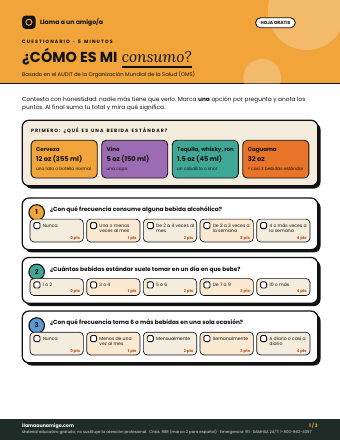
Preview: How much do I drink?
Questionnaire · 3 pages

How much do I drink?

The World Health Organization's AUDIT questionnaire: 10 questions to measure your drinking, with a results table.

Download PDF
Preview: My weekly log
Log · 1 page

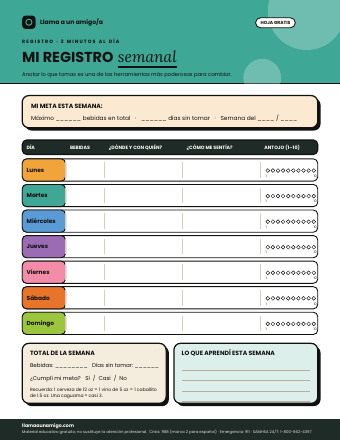
My weekly log

Write down how much you drink, where, how you felt and how strong the craving was each day.

Download PDF
Preview: When the craving hits
Skills · 2 pages

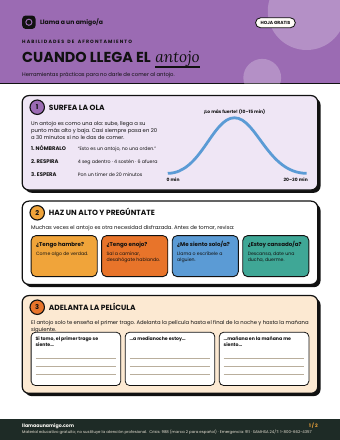
When the craving hits

Surf the wave, take a HALT, play the tape forward and 18 things to do instead of drinking.

Download PDF
Preview: My traffic light
Plan · 1 page

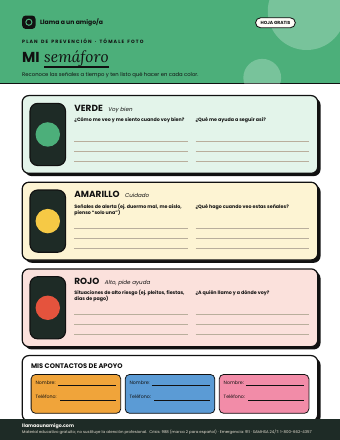
My traffic light

Your prevention plan: green, yellow and red signs, what to do and who to call.

Download PDF
Preview: When someone I love drinks
For families · 2 pages

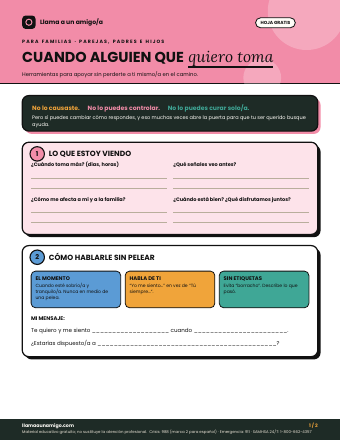
When someone I love drinks

How to talk without fighting, what helps, how to set limits and take care of yourself.

Download PDF
Preview: Take back control
Gambling · 1 page

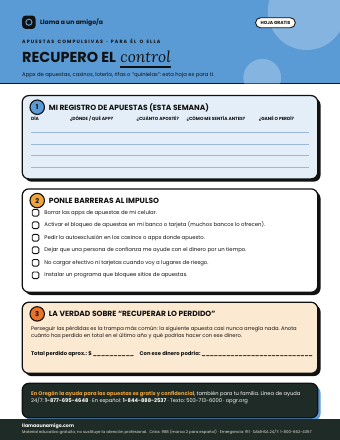
Take back control

Betting log, barriers against the urge and the trap of “winning it back.”

Download PDF
Preview: My reasons to change
Motivation · 1 page

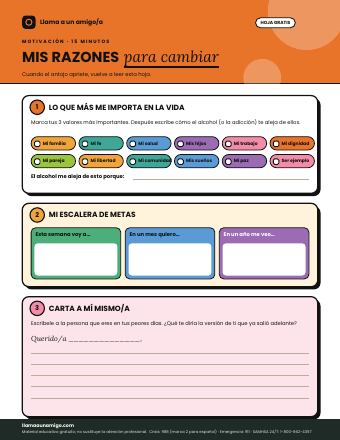
My reasons to change

Your values, your goal ladder and a letter to yourself for hard days.

Download PDF
Preview: Calm your body without alcohol
Stress · 1 page

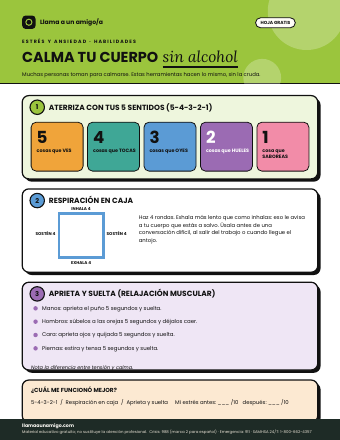
Calm your body without alcohol

5-4-3-2-1, box breathing and muscle relaxation to lower stress without drinking.

Download PDF
Preview: Caring for me too
For women · 1 page

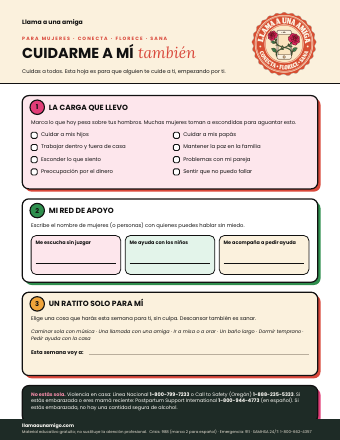
Caring for me too

The load you carry, your support network and a little time just for you. From Llama a una amiga.

Download PDF

Or fill them in right here

Who is this worksheet for?

Important for your health: if you drink heavily every day, don't stop suddenly without talking to a doctor. Withdrawal can cause tremors, seizures and other serious risks. Cutting back with medical support is safer.

1. My triggers

10 min

Think about the last few times you drank more than you meant to. Triggers tend to repeat: a place, a person, a feeling, a time of day.

Where / with whom? What was I feeling? What did I do? What can I do differently?

2. Surf the craving

When the craving hits

A craving is like a wave: it rises, peaks and falls. It almost always passes in 20 to 30 minutes if you don't feed it.

  1. 1Name it“This is a craving. It's not an order.”
  2. 2BreatheBreathe in for 4 seconds, hold for 4, breathe out for 6. Repeat 5 times.
  3. 3Notice itWhere do you feel it in your body? From 1 to 10, how strong is it?
  4. 4MoveGo for a walk, drink water, eat something or call someone.
  5. 5Measure againAfter 20 minutes, from 1 to 10, how much is left?

3. The balance

10 min

Be honest with yourself. Alcohol gives you something, or you wouldn't use it. Seeing both sides helps you decide.

4. My emergency plan

Take a photo of it

First, something you should know: you didn't cause the addiction, you can't control it and you can't cure it alone. But you can change how you respond, and that often opens the door for your loved one to seek help.

1. What I'm seeing

10 min

2. How to talk without fighting

Prepare your words
Pick the momentWhen they're sober and calm. Never while they're drinking or in the middle of a fight.
Talk about yourself“I feel…” instead of “You always…”. Accusations close the door.
No labelsAvoid “drunk” or “alcoholic.” Describe what happened, not who they are.

My message

3. What helps and what doesn't

What helps

  • Spending quality time with them when they're sober.
  • Saying the good days out loud.
  • Letting them face the consequences of their choices.
  • Having a professional's name ready for when they say “yes.”

What doesn't help

  • Arguing when they've been drinking.
  • Covering for them: lying to their job, paying their debts, cleaning up after them.
  • Threats you won't follow through on.
  • Hiding or throwing out bottles behind their back.

4. My limits and my self-care

A limit isn't a punishment. It's what you will do to protect yourself. “If you come home drunk, I'll spend that night at my sister's.”

Your safety comes first. If there's hitting, threats or fear at home, call 911 or the National Domestic Violence Hotline: 1-800-799-7233 (in Spanish too, 24/7).

Worksheets help. Talking heals.

Bring what you wrote to your first confidential session.

I want to talk to someone

Free help 24/7: SAMHSA National Helpline (alcohol and drugs, in English and Spanish) 1-800-662-4357 · Crisis: 988 (press 2 for Spanish) · Emergency: 911. These worksheets are educational and do not replace professional care.